


“Cycle syncing” is trending, but it’s not just about exercising when we have our periods. It’s about actually planning an exercise around the entire month of the menstrual cycle. Some believe this planning can help alleviate some discomfort or pain associated with menstruating, hormonal changes, and can help us feel happier overall.
Researchers at Harvard have recently shared new observations from their Apple Women’s Health Study to help us understand more. In reviewing over 22 million workouts with 110K consenting participants, there were some surprising findings.
Across cycles, the top five types of exercise were walking, cycling, running, functional strength training, and yoga.
There was a median of 21 minutes of exercise each day in the follicular phase, compared to a median of 20.9 minutes of exercise each day in the luteal phase (the two phases identified in our menstrual cycle each month). Daily exercise minutes were very similar, no matter the cycle phase.
Participants who reported regular menstrual cycles did more exercise minutes per day overall, compared to participants with irregular cycles. The participants with regular cycles typically had 20.6 minutes of exercise per day. Participants with irregular cycles typically had 18.6 minutes per day. Irregular cycles can be caused by many factors, some of which may make it hard to exercise.
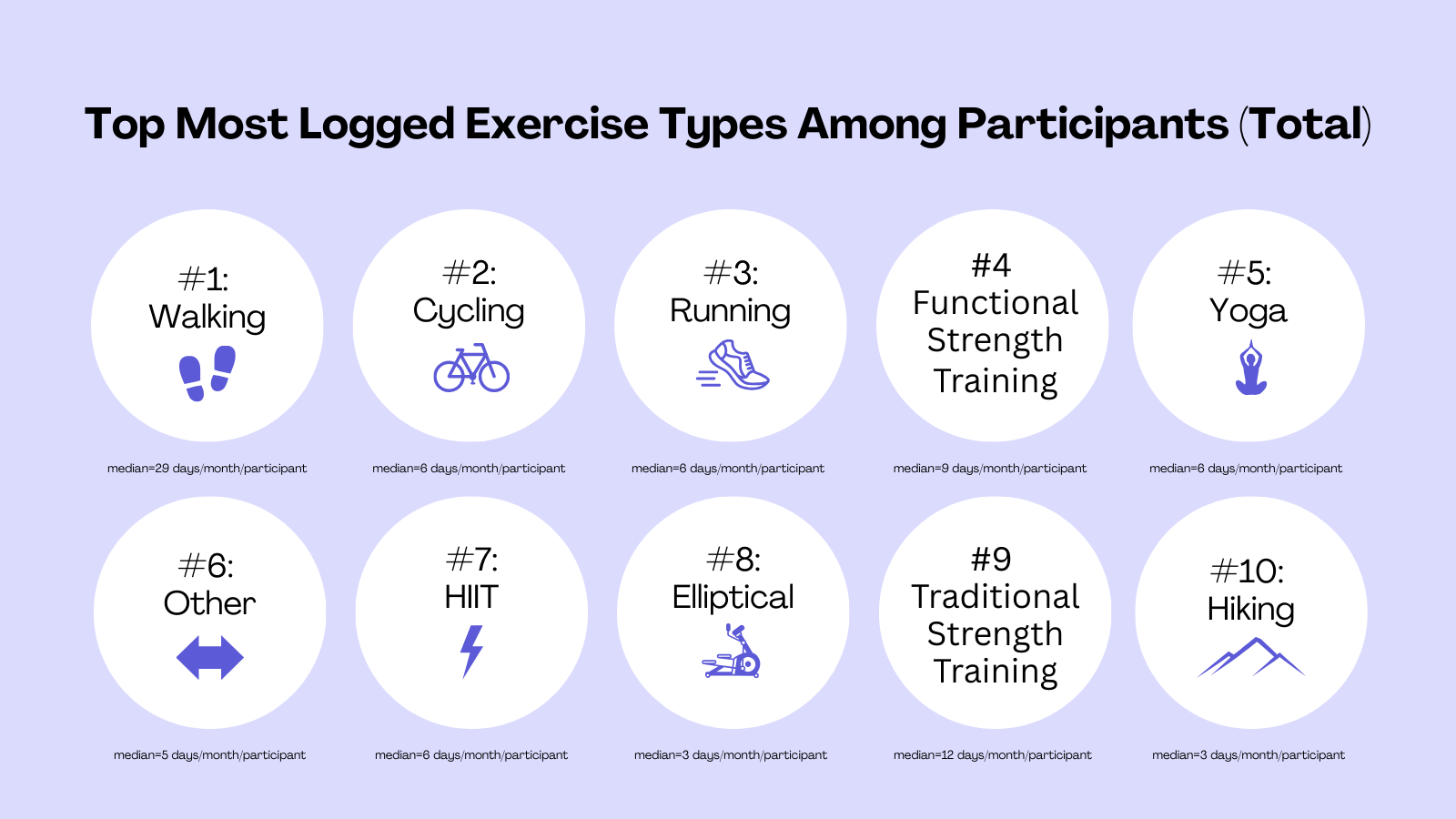
According to the researchers, this analysis describes how participants are exercising the same amounts during both phases of their menstrual cycle. Exercise is important and can be beneficial during all stages of the menstrual cycle. Many people are staying active no matter the cycle phase and reaping the benefits of exercise. Not only can it help boost our mood and energy levels, but exercise also helps us overall in the long run. Just find what you love to do and keep moving!
By the way, multiple data sources were used in the study. This includes the demographics survey, the medical history survey, the reproductive history survey, Apple Watch Activity rings summary data, Apple Watch stand hours data, cycles data, and menstrual surveys.

Interesting, right? If you want to dive deeper into the research, here’s a link to the Harvard Apple Women’s Health Study.
About the Harvard Apple Women’s Health Study:
In the first study of its kind, the Harvard T.H. Chan School of Public Health has teamed up with Apple and the National Institute of Environmental Health Sciences (NIEHS) to gain a deeper understanding of how certain demographic and lifestyle factors could have an impact on menstrual cycles and gynecologic conditions including infertility, menopause, and polycystic ovary syndrome (PCOS).
The cycle tracking data from your iPhone and/or Apple Watch (optional), along with participants’ survey responses, will help inform the development of innovative products for menstrual cycles, risk assessment, and screening of gynecologic conditions.